

Owning $WALLET Means Owning Ambire
Ambire isn’t just a wallet you use. It’s one you can own. All revenue from in-wallet swaps, bridges, and gas payments goes to $WALLET buybacks. Holders govern how those tokens are used, and staking brings fee discounts, full voting power, and 2% APY.


TL;DR
- Ambire currently earns fees from in-wallet swaps, bridges, and transactions broadcast with Gas Tank or tokens. Additional revenue streams are work in progress.
- All revenue goes to $WALLET buybacks, taking tokens from the open market and putting holders in charge of how funds are used.
- $WALLET and $stkWALLET holders govern what happens with bought-back tokens via governance voting. Anyone can open a vote.
- Staking your $WALLET for $stkWALLET comes with trading fee discounts (down to 0%), 2% APY staking rewards, and full voting power.
- Visit the $WALLET token dashboard for token analytics.
Value accrual
We believe tokens are a better way to create and distribute value than equity. That’s why all of Ambire’s value accrues to $WALLET with no separate cap table capturing the upside. Owning the token means owning Ambire.
As the wallet grows and generates more revenue, that growth is reflected in the token rather than siphoned off elsewhere. All revenue flows back to the token through buybacks, and token holders govern the treasury allocation.
$WALLET is designed to capture the value generated by the wallet and benefit its owners.
Revenue streams
Today, Ambire earns revenue from swaps, bridges, and transactions paid with the Gas Tank or tokens. The wallet has been growing in user base, and we’ve only just begun to monetize it. We’re carefully exploring new revenue streams that add value for users rather than taking it from them.
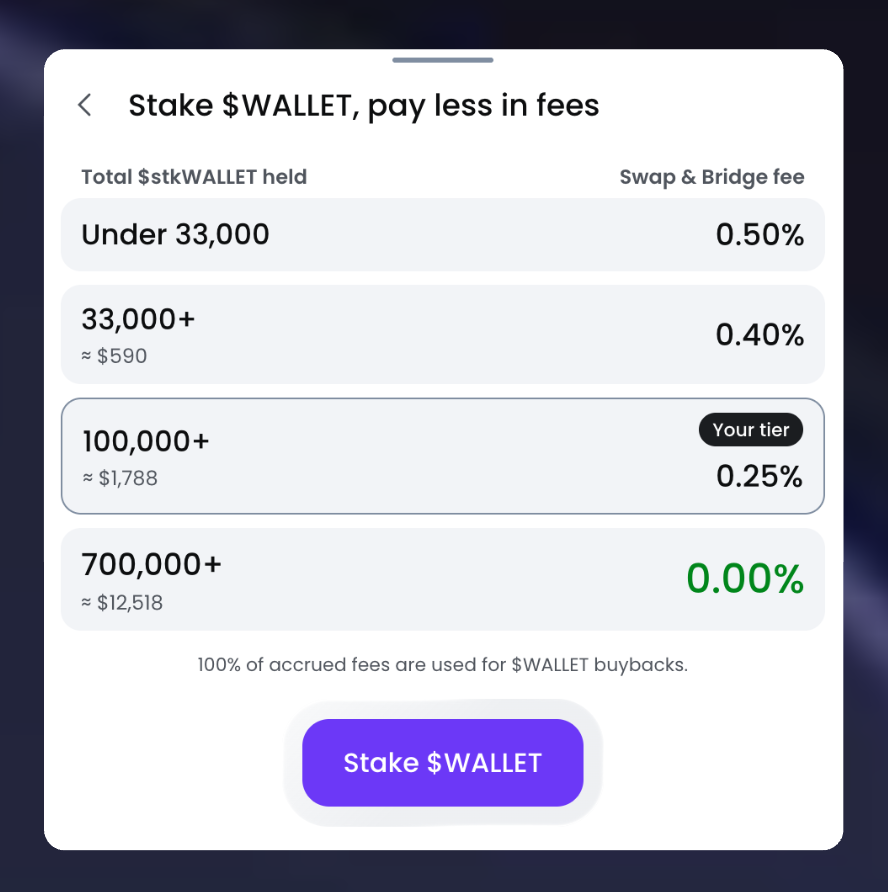
Every time a user swaps tokens or bridges assets through Ambire's built-in Swap & Bridge feature, Ambire charges a fee ranging from 0.5% to 0%, depending on the user's staked $WALLET token holdings.
Ambire charges a small convenience fee when users pay for gas with their Gas Tank balance or any of the 100+ supported tokens, including stablecoins. This gives users the flexibility to transact without holding a network’s native token. Paying gas in the native token incurs no additional fee.
100% of revenue is used to buy back $WALLET on the open market.
The repurchased $WALLET is held by buybacks.ambire.eth, and its use is decided through governance, so token holders determine how those funds are allocated.
Up next, we’ll be exploring monetization of private transfers and the Ambire Ice hardware wallet. The “Explore” tab in the wallet perfectly fits future integrations and revenue streams for perps, prediction markets, on - and off-ramps, earning opportunities, and more.
Staked $WALLET perks
$WALLET is Ambire’s native token, and staking it earns you $stkWALLET at a 1:1 ratio, keeping your position simple to track. Holding $stkWALLET comes with three main benefits: lower trading fees in Ambire, full voting power in governance, and a 2% APY.
Staking and unstaking are built right into Ambire, so you can manage your position in a few clicks without leaving your wallet or connecting to an external app.
Reduced trading fees
Ambire’s built-in Swap & Bridge lets you swap, bridge, or execute cross-chain swaps from a single interface and quotes all major aggregators.
The standard trading fee is 0.5%, but it drops based on how much $stkWALLET you hold. The more you stake, the less you pay, and fees drop all the way to 0%.
Full voting power in governance
Ambire Governance shapes the key decisions about the wallet’s development, $WALLET, and its tokenomics. Anyone who holds over 45k $WALLET or $stkWALLET can open a governance proposal. The team has been the main source of proposals up to now, but the door is open to all.
For example, if protocol/app XYZ builds an integration with Ambire and a governance vote approving it passes, Ambire will integrate the app natively in the “Explore” section, just as Ambire Staking is integrated today.
Each proposal starts with a temperature check posted on social and community channels to gauge interest and gather feedback before moving to a formal vote.
Both $WALLET and $stkWALLET holders can vote, but staking gives you a stronger voice: $stkWALLET carries full voting power (1x), while unstaked $WALLET counts at 0.5x.
Browse past proposals on Ambire Snapshot.
Staking APY
Stakers get a 2% APY on their staked $WALLET. There is no manual work, and the yield is automatically added to your balance. Governance approved the current staking mechanics, which include annual issuance equal to 2% of the staked supply.
$WALLET token dashboard
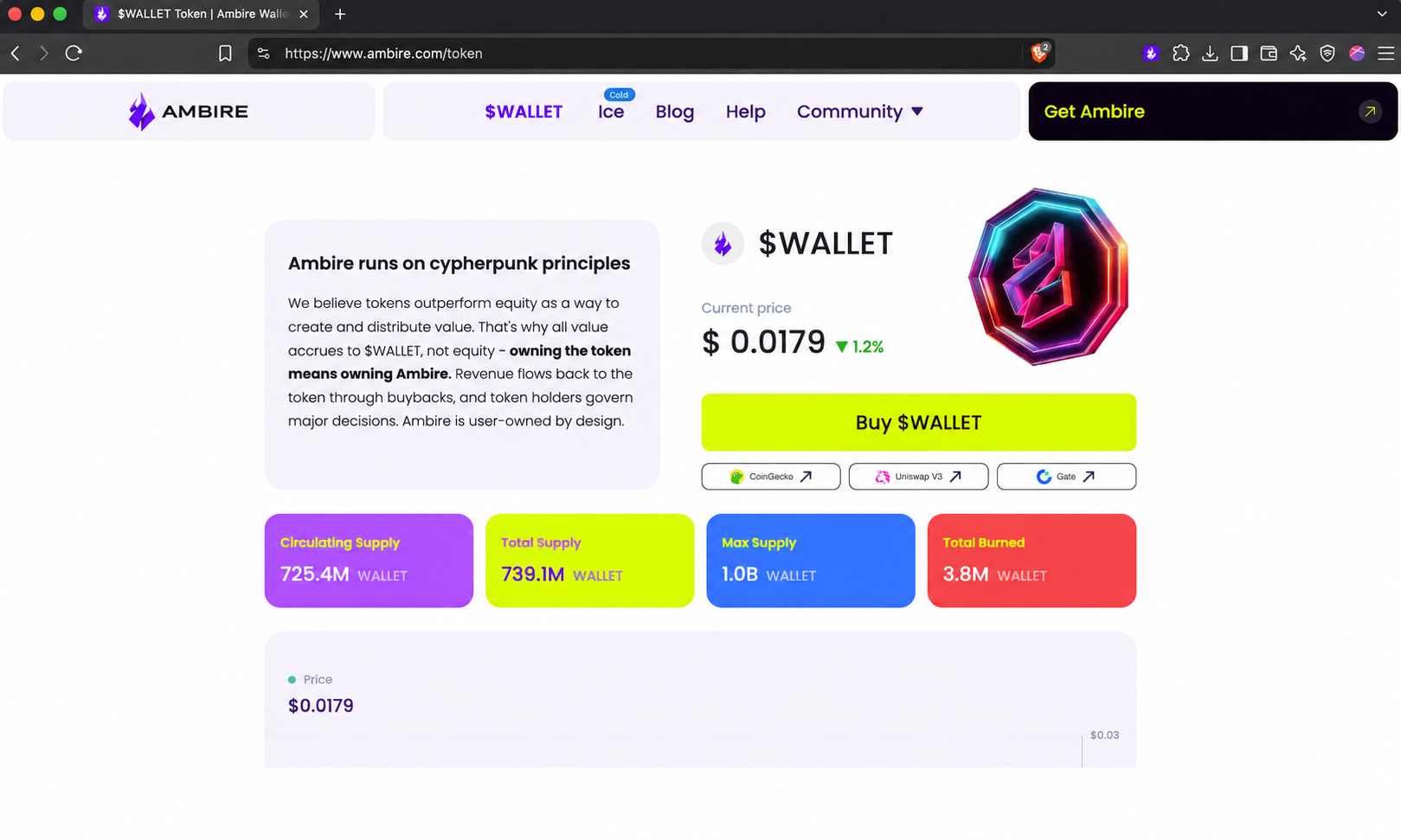
We created a page that helps holders track $WALLET general info, holders, governance stats, and buybacks. We welcome your ideas on how to improve it.
FAQ
What is the difference between $WALLET and $stkWALLET, and how do I stake?
$WALLET is the native Ambire token, and $stkWALLET is the staked version. You can stake or unstake tokens right inside the Ambire extension and mobile wallet.
Who can participate in Ambire Governance and where does the voting take place?
Governance votes take place in Ambire Snapshot. Anyone holding $WALLET or $stkWALLET before a governance vote opens can take part. Staked tokens count fully (1x), while unstaked $WALLET counts at half weight (0.5x).
Can I trade $stkWALLET for $WALLET in Ambire?
There is a community-made pool on Uniswap, but liquidity is low. We recommend staking and unstaking tokens right inside Ambire.
How to stake $WALLET and unstake $stkWALLET?
Follow this step-by-step guide in the Ambire Help Center.
Who are the largest $WALLET holders and where can I get up-to-date token information?
You can track $WALLET metrics in detail on the $WALLET token dashboard.
Where can I buy $WALLET tokens and where is it listed?
We recommend buying $WALLET on Ethereum, where liquidity is deepest. You can find all available markets on CoinGecko.
Interested in Ambire? Follow us:
Discord | X (Twitter) | Reddit | GitHub | Telegram
